Saturday, November 12, 2011

Last bit of North Korea

This is the last I'll say about North Korea, I promise! Mostly just a few last pictures and things that I wanted to show.

First of all, here are some postcards I bought. (Some of you might recognize them if I sent you one!) They did have 'normal' postcards of the famous sights and monuments, but those were pretty boring, not great quality, and I took a lot of the same pictures myself. THESE, on the other hand, are definitely one-of-a-kind!

I asked my coteachers for help translating them, and they found it pretty difficult. There is a difference between the North and South Korean dialects, and the slogans can use some Chinese characters or vocabulary that South Koreans might not be familiar with. They're all related to propaganda - these are images that North Koreans see every day, so it's about patriotism, preserving a Socialist lifestyle, working hard, independent reunification of the Koreas, etc.


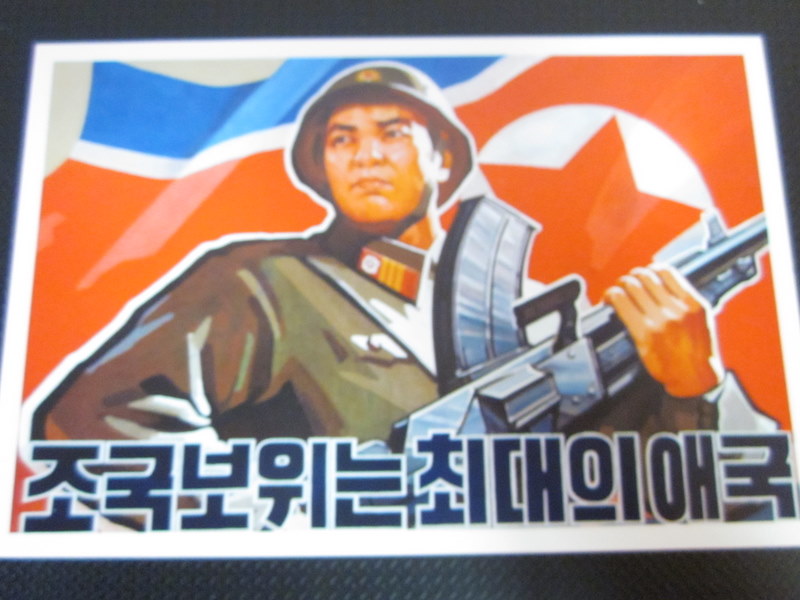
Everybody I mailed a postcard to said that they received it, but I can only imagine what some of the USPS staff were thinking as they processed these!

Here is a great video that a member of our tour group put together. Adam did a really nice job, and there beautiful shots of things like Mt. Paekdu and the Mass Games! I love this video. If I were a computer whiz I could probably figure out how to embed it right here, but I'm not so here is the link for you to copy and paste: http://vimeo.com/28455309

I make a brief appearance, staggering up Mt. Paekdu and getting sunburned. The song is "Truck" by Octopus Project, a band from Adam's hometown of Austin, TX.

And last but not least: here is proof that the DPRK can do some things right. Pyongyang is home to an amazing subway system. It's the deepest metro system in the world, and doubles as a nuclear bunker in the event of an imperialist attack. It took forever to get to the stations - riding in an ancient escalator over 350 feet below ground! We were able to ride the subway two or three stops, getting off and on to take pictures of the different stations. The metro stations are gorgeous, in a very 1970's way - chandeliers, murals (of course), statues of Kim Il Sung (of course) and lots of marble.

Have you ever ridden an escalator where you couldn't see the bottom or the top?! Creepy!


A map of the Pyongyang Metro System's two lines.

You can read the daily paper while you wait!


You can also see a bit of the metro system in Adam's video. All in all, I'd say the cleanliness and decor puts most Western and South Korean metro or bus terminals to shame.

Sunday, November 6, 2011

North Korea IV: In Which You Receive Indoctrination

The North Korean government has mastered the art of propaganda. There are no advertisements or billboards anywhere, just murals, monuments, memorials, and posters glorifying Kim Il Sung, Kim Jong Il, the communist party, the general superiority of the Korean race, Korean revolution, victory over oppression (Japanese colonialism or American imperialism) and the reunification of the two Koreas. So a huge percentage of our sight-seeing was being herded from one monument, to the next statue, and then on to the next memorial.


They all started to look the same after a few days, and it was a little creepy to see Kim Il Sung EVERYWHERE.


Some of the mosaics and paintings were actually quite pretty (though not any less weird):


The sights themselves usually weren't that impressive (except in their sheer abundance), but then again, the real fun on a DPRK tour is learning how the Koreans explain, justify, or behave around them.

It was obnoxious and boring for us as tourists, to hear about Kim's revolutionary exploits and general awesome-ness day in and day out, but I can't imagine living like that all the time - growing up with an almost maniacal obsession with past insults, revering a dead man as your savior and "Eternal President", and constantly harping on what your enemies have inflicted on you in the past or what they could be plotting against you right now...

North Koreans interpret their history, and still see themselves today, in terms of their enemies. The darkest period in Korean history was the Japanese occupation from 1910-1945. The South has been able to move forward, but to the North, Japan is still an evil colonial power. Then there was the Korean War; according to the North, it was instigated by the 'American imperialists' or 'American aggressors' (they never say just 'America' in the DPRK, they always use some flattering description) and the South was/is a puppet of the imperialists. The extent to which the North clings to this is amazing. The propaganda keeps those times fresh in the people's minds, and the government can use it to justify their actions today. Kim Il Sung is next to a god, because he saved them from both the Japanese and the Americans.

Kim Il Sung also designed the philosophy of Juche, to guide North Korea and further justify the government's policies. Juche is one word that sums up an entire lifestyle, so it's a little difficult to define, but: Juche philosphy basically means self-reliance, independence, and the power of the Korean people to be their own masters and define their own futures. The defense of the DPRK always comes first, the DPRK doesn't need outside help or resources, and history must be remembered in order to inspire patriotism and love of the motherland. Explains a lot, doesn't it?


And what would Juche be without a monument!? Unveiled on the Eternal President's 70th birthday, and built with no more and no fewer than 25,550 bricks - one for each day of the President's life up to the unveiling. (Thanks to the Wikipedia article on 'Juche' for helping me to articulate that part!)

Sunday, September 11, 2011

Mount Paekdu


Another major highlight of my North Korean tour was our visit to Mt. Paekdu. Mt. Paekdu is the highest mountain on the entire Korean peninsula, and it's way, way the hell up north, right on the Chinese border (there are still arguments about whether Paekdu belongs to Korea or China).

Mt. Paekdu is really important for a lot of reasons; it's the highest mountain on the entire Korean peninsula; it has a huge crater lake at the top (the mountain is an inactive volcano); it's difficult to get to and really beautiful; and it’s a very historic, sacred site. Koreans believe Mount Paekdu to be the site of the origin of the Korean people, the foundation of their race and country. It's a sacred place and traditionally a site of worship.

It's especially important to North Koreans because during both the Japanese occupation and the Korean War, anti-Japanese and Communist guerillas were organized there (Kim Il Sung and his secret camps). Kim Jong Il was also supposedly born there (most Western sources say otherwise). So there are tons of reasons to see Mt. Paekdu, besides the awesome natural scenery.

We spent one night and two days in the Mt. Paekdu area, and it was really fun and so different from Pyongyang. We chartered a flight to a town called Samji, and once we were in Samji, I could see why we had to fly. Barely any roads in the region are paved, so we were bouncing around for hours at a time in our minibus, covered in dust, going down tiny, narrow dirt roads. The scenery was so beautiful – really wooded (reminded me of Michigan’s Upper Peninsula) and mountainous, with the occasional waterfall. The coolness was a welcome change after the heat and humidity of Beijing and Pyongyang.


But getting to Samji was only half the battle. Since it's so far north and the terrain is so (duh) mountainous, Mt. Paekdu itself is only accessible for a few months every year. The crater lake, Lake Cheon, is frozen 8.5 months out of twelve, and our guide Mr. Oh said that in winter, the winds can literally blow people away. The average temperature at the peak hovers around 17 degrees Fahrenheit (it was nice and cool in August – perfect hiking weather).

We drove a ways, maybe an hour, from Samji to the mountains. At Mt. Paekdu, the funicular wasn't working (‘temporarily out of order’) and our little bus could only go so far, so we had to walk the last 45 minutes up to Lake Cheon.


The view was worth the walk:


And the world's most worthless funicular:
This isn’t even the highest point – we could have walked a few more minutes to another vantage point, but I was tired and the view would have been about the same. We also had the option of walking down to the edge of Lake Cheon. It would have been amazing, but I never would have made it back up those hundreds of stairs!


When we were done, someone told us that it would be faster to walk down the funicular track, rather than down the path that we had walked up on. I don’t know if it was faster or not, but walking down the funicular was hard (so, so steep, my knees were killing me by the end) and at times really scary – boards were rotted out, the handrails were rusty, the whole thing was creaky and practically swayed in the wind. I’m scared of heights so I just crept down, and it took me about as long going down as it had going up!


Obviously the problem was more than temporary!

Besides Mt. Paekdu, we saw the secret camp where Kim Jong Il was supposedly born while his parents were busy stomping out the Japanese and imperialist aggressors. There are tons of secret camps in the northern mountains of the DPRK, but this one was particularly touching - we could see Kim Jong Il's childhood toys, as well as his baby blanket (made from bits of cloth given by the female guerillas, from the uniforms off their backs). There was also a really pretty waterfall and the Samjiyon Grand Monument, a historic battle site with monuments to the Juche philosophy and our favorite Great Leader.


Overall, the Mt. Paekdu area was a really nice overnight trip – we could get out of the city and see a different side of the DPRK. I’m a total sucker for trees and mountains and natural scenery, so this was my favorite part of the country.


And obviously the Kims share my good taste: